

Introduction
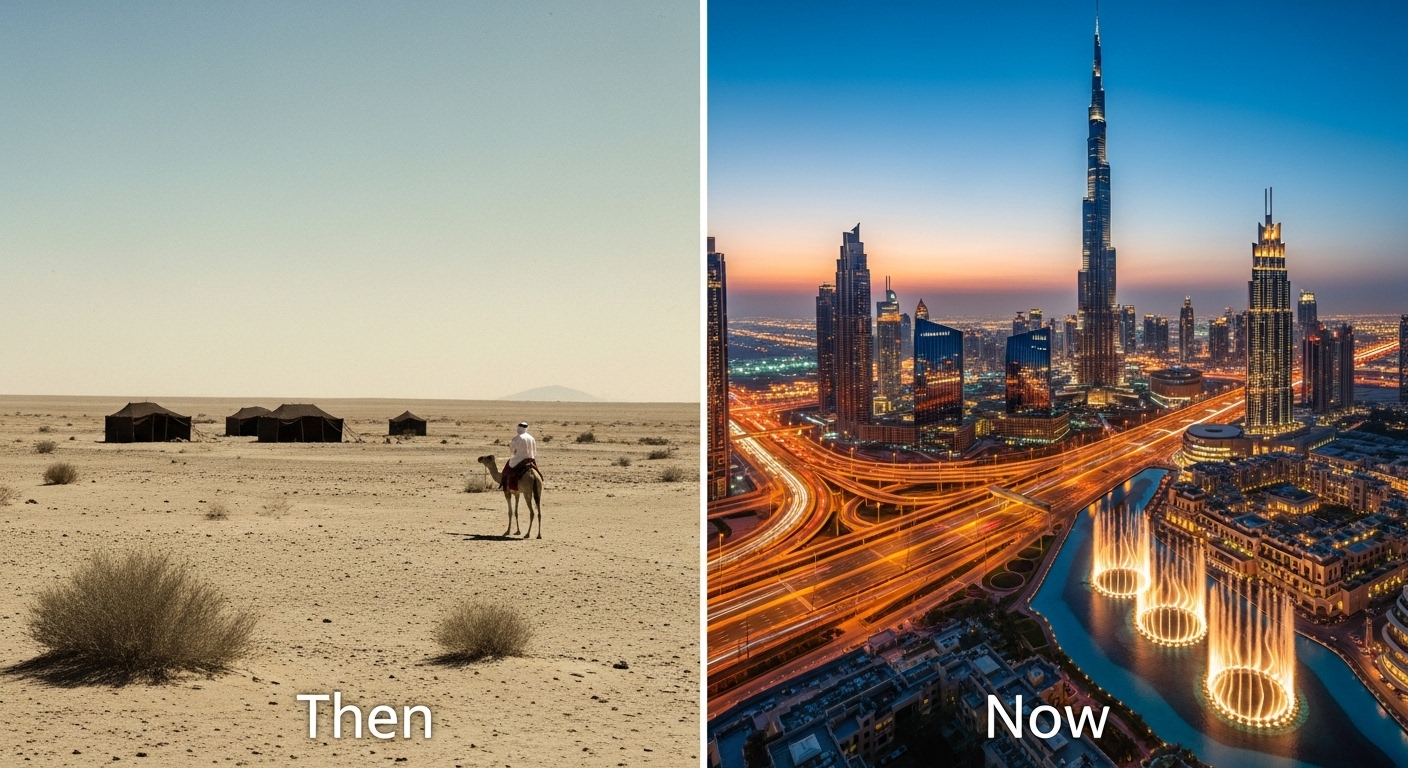
The most powerful visual narrative of the United Arab Emirates is not a single image, but a dialogue between two: the “then” and the “now.” This practice of juxtaposing historical photographs with contemporary shots of the exact same location has become a compelling genre in its own right, offering a breathtakingly clear measure of the nation’s transformation. These diptychs do more than document change; they tell a story of audacious vision, relentless execution, and a quantum leap from a modest past to a spectacular present, all within the span of a single human lifetime.
History
The “Then and Now” genre gained popularity with the advent of the UAE’s major anniversaries, such as its 40th and 50th National Days. Photographers, both professional and amateur, began scouring archives for old images of streets, squares, and coastlines. They would then return to the precise spot, often using architectural landmarks or mountain backdrops to align their modern shot, to capture the staggering contrast. The genre was popularized by books, social media campaigns, and exhibitions, becoming a popular and accessible way for everyone to engage with the nation’s history and celebrate its progress.
Key Features
This photographic technique is defined by its direct comparative power:
- The Power of Precision: The impact relies on the careful alignment of the old and new frames. Seeing the same curve of a creek, now flanked by skyscrapers instead of wind towers, makes the transformation undeniable and personal.
- A Focus on the Urban Fabric: Common subjects include the Dubai Creek, the Corniche in Abu Dhabi, and the central squares of Sharjah and Al Ain. These are places that were once the heart of the old community and are now the nucleus of the modern city.
- Narrative of Progress: The genre inherently tells a story of advancement—from sand tracks to 12-lane highways, from barasti (palm frond) huts to glass towers, from dhows to luxury yachts. It visualizes the national narrative of triumph over a harsh environment.
- Emotional Resonance: For older Emiratis and long-term residents, these comparisons evoke a powerful sense of nostalgia and wonder. For the young and newcomers, they are a shocking revelation of the scale of change that has occurred in such a short time.
Cultural Significance
“Then and Now” photography has become a vital tool for cultural memory and national identity. It visually answers the question, “What was here before?” It grounds the modern, sometimes surreal, cityscape in a tangible history, preventing a sense of rootlessness. This practice fosters a collective appreciation for the struggles and achievements of the founding generation. It is a democratic form of storytelling that allows every citizen to see themselves as part of this continuing narrative of growth and to understand their place in the nation’s journey.
Modern Relevance
This genre is more relevant than ever as the pace of change continues to accelerate. It serves as an ongoing historical record, with each new “Now” photo becoming a “Then” for future generations. It is widely used in educational materials to make history tangible for students. Furthermore, it has become a form of popular social media engagement, with hashtags like #MyDubai and #ThenAndNow encouraging residents to explore their urban environment and contribute to this collective visual archive. It turns every citizen into a potential historian and documentarian.
Conclusion
“Then and Now” photography is the most visceral and easily understood history lesson the UAE has to offer. It transforms abstract concepts of development and GDP growth into concrete, visual facts. The stark contrast between the two images is a silent but eloquent tribute to the vision of the nation’s leaders and the hard work of its people. This genre does not just showcase the transformation of a landscape; it captures the metamorphosis of a society, proving that the UAE’s past is not a separate country, but the very foundation upon which its dazzling present was built.